

The role of HR in startup scaling: why Woola hired an HR person for a team of 10 people.

Startups are often characterised as fast-moving, high-energy environments fueled by passion and grit. In the early days, “HR” might simply mean the founders squeezing in hiring between product sprints and investor meetings. As the company scales, people challenges quickly become business challenges. This is where HR evolves from an afterthought into a strategic partner.
At the beginning, HR is informal by necessity. Hiring happens through networks, onboarding is minimal, and policies are unwritten. Culture forms organically, shaped by the founding team. At this stage, speed matters more than structure. But as headcount increases, cracks begin to show. What worked for 10 people won’t work for 50. HR becomes tied to retention, productivity, and long-term success.
What are we doing differently at Woola?
At Woola, values and culture are central. From the start, we focused on building a team that genuinely lives them. The founders recognised early that a strong team would determine the company's success. With an ambitious mission, that meant hiring not just capable people, but the right people. Holding the team together, really listening, and creating a healthy working environment have led to us receiving an eNPS score of 100 several times. We’re proud of this achievement and know we need to continue working hard to keep it that way.
We chose not to wait for growth and problems to bring in the HR hire. We decided to build things correctly from the ground up and work on preventing issues rather than fighting fires at a later stage. This approach requires more time and money upfront, but it pays off. Hiring mistakes, unresolved conflict, and weak leadership are all costly, especially when ignored early on.
What does an HR person do in such a small team?
Here are a few of the areas where HR has the biggest impact at Woola.
Building a strong team from day one
Recruitment shouldn’t be something that’s done without thinking through the process and needs. It can lead to wrong hiring decisions that can be costly for the company. Having a dedicated person to run the recruitment process from scratch makes a significant difference. We’re able to mitigate risks of hiring bias and put together clear role definitions and expectations.
It also allows us to give thoughtful feedback to every candidate. Even when we reject someone, the experience remains positive. Over time, this builds a strong reputation that supports future hiring.

Feedback from a candidate ‘Thank you for a very sweet reply. The best candidate experience I’ve had by far’
Managing growth and conflict
This is one of the main reasons we brought in HR early. With more people comes more friction. Conflict is inevitable, but unmanaged conflict is costly. As the team grows, miscommunication and personal concerns increase, and need to be addressed before they escalate.
At Woola, we run 1-on-1s not just with the direct manager but also with HR. Concerns surface earlier, and issues are resolved before they grow. The result is a more open, psychologically safe environment where people feel comfortable speaking up.
This setup works well for a small team. As the company grows, responsibility naturally spreads, and different structures are needed. But at an early stage, this approach can make a meaningful difference.
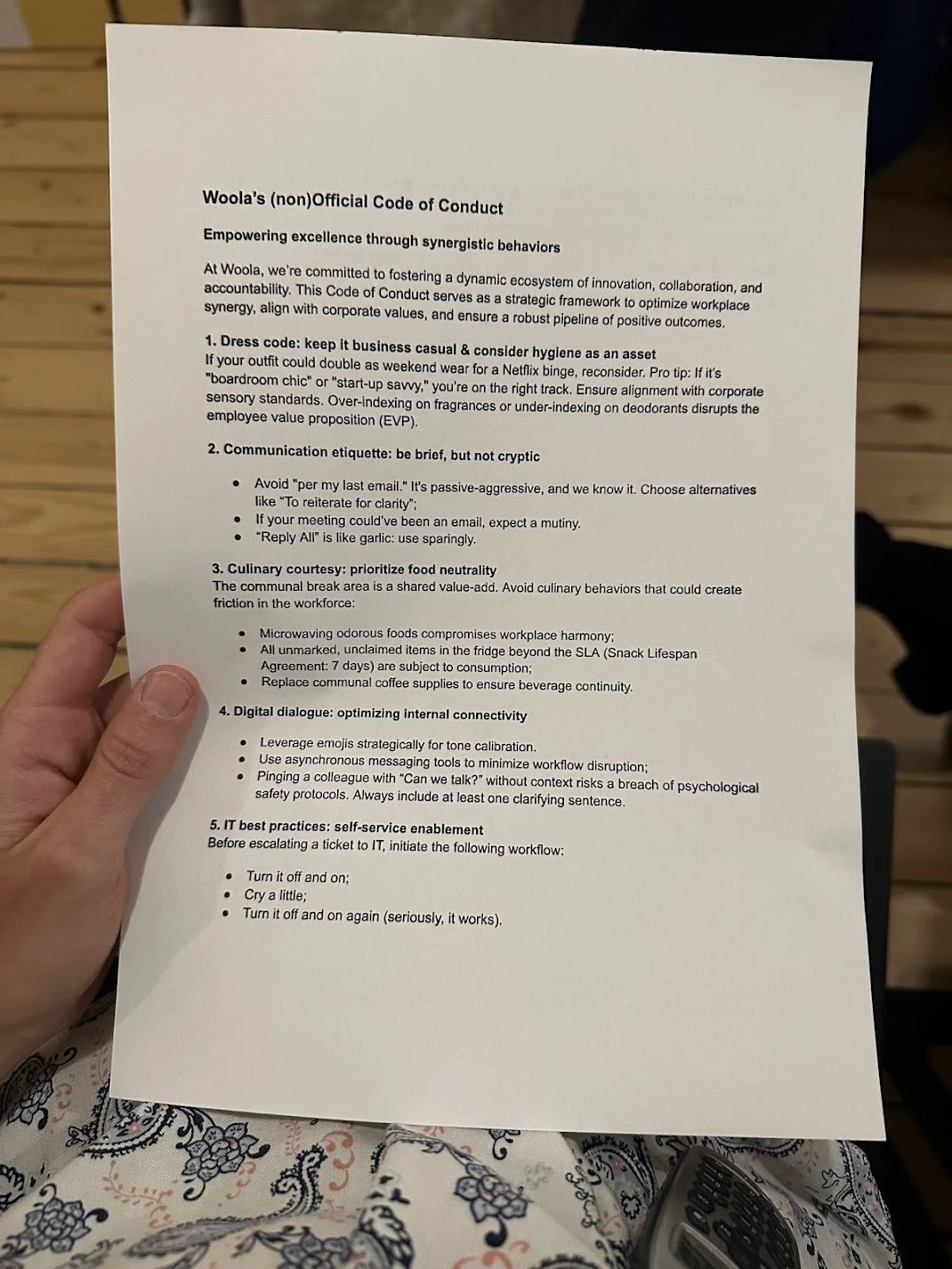
Getting Compliance right early
Compliance sounds like a dirty word for many start-up employees. Something to be avoided because it’s ‘just so corporate’. In reality, it protects the company legally and creates clarity and consistency in decision-making. It may feel like a burden, but ignoring it is risky. As the company grows, so does regulatory exposure.
Many small businesses and start-ups rely on AI-generated or online employment contract templates and use the ‘let’s hope for the best’ approach. It works…until it doesn’t.
Having HR ensure compliance from the beginning helps avoid future problems. This includes employee relations, workplace safety, and data protection. It becomes even more important in international teams, where legal requirements quickly become more complex.
Designing scalable (HR) processes
In a small team, processes can feel like unnecessary bureaucracy. And sometimes, they are. Processes shouldn’t exist for their own sake, but a lack of clear processes only works up to a point. As teams grow, alignment becomes harder, and expectations start to drift. The key is to keep things simple while thinking ahead. Build processes that can evolve instead of starting over later. Some of the things we have focused on at Woola include:
Onboarding: we want to make sure every new joiner has a strong start at Woola. This means setting up the calendar before they start, putting together a strong onboarding plan, setting 30-60-90 day goals, and integrating them into our culture.
Documentation: not only is it important from a legal point of view, but it’s also important for IT security, and let’s be honest, it just makes everyone’s lives easier.
Performance management & salary reviews: employee growth and transparency in the way we approach salaries is key to us.
Recruitment: great candidate experience, data protection, and finding the right person all come into play here.
Final thoughts
Scaling a startup is as much about people as it is about product or revenue. HR plays a critical role in navigating this journey, balancing structure with flexibility, and growth with sustainability. Today, Woola has grown to a team of 20, and we can already feel the difference.
The most successful startups are not just those that scale fast, but those that scale well. And more often than not, that’s an HR story.